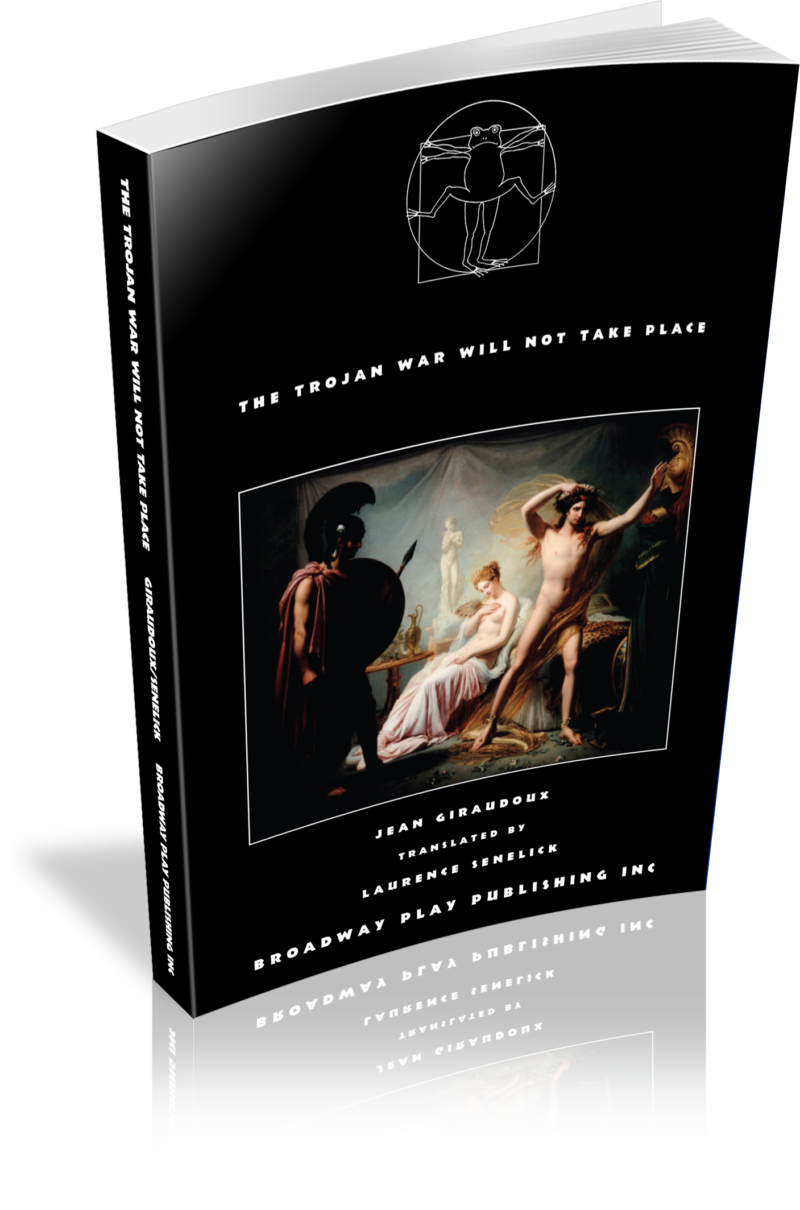
The Trojan War Will Not Take Place
Price range: $15.00 through $15.95
Description
Hector, the peace-seeking leader of the Trojans, attempts to stop a war sparked by his brother Paris taking Helen. He appeals to the Greek strategist Ulysses in hopes of settling the matter without bloodshed, but warmongers pushing for battle and human stubbornness make the conflict unavoidable.
Production Info
Full Length Drama (about 120 minutes)
Minimal Set Requirements
Period Costumes
Press Quotes
“The theme is profoundly serious. But Giraudoux could not wear a solemn look. Most of the play is funny. It is a satire not only on the grandeur of Homeric characters but on the congenital stupidities of human nature.” —Brooks Atkinson
“It is a drama that comes to grips with major ideas but never loses its fluidity as an item of stagecraft. The barbs literally fly across the stage, but, withal, there is a perception that is continuously absorbing.”—Jack Gould
“It is this dialectic or linguistic push-pull effect, operating on so many levels of the play, separating and uniting, ordering and disordering, advancing and stalling that gives the play its powerful unity, a unity both diachronic and synchronous, in and out of time; it is this that establishes Giraudoux as an authentic poet of the theater. His theater is not grounded in plot or in character or in those ideas whose absence was pointed out by Sartre; it is grounded in language.” — Neal Oxenhandler
“The play’s dialogue, spoken on a stage, is not essentially addressed to the characters who hear it within the stage space. In the theatre it is spoken to others, the audience, and not to the characters on stage, and beyond the audience to all future readers, and that public, actually absent from the playhouse, will alone assure the survival of the universe thus created.” —Luc Froisse
Author
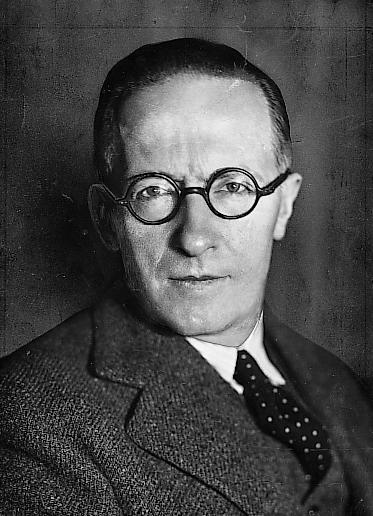 Jean Giraudoux
Jean Giraudoux was a French playwright, novelist, and diplomat whose witty, originally expressed works in an impressionistic style helped free French theater from the restrictions of realism. He wrote fifteen internationally acclaimed plays, most initially staged by the actor-director Louis Jouvet. Giraudoux was born in the village of Bellac on October 29, 1882. He received his education at the École Normale Supérieure in Paris, the University of Munich, and Harvard University. In his youth Giraudoux traveled extensively to Germany, Italy, the Balkans, Canada, and the United States, where he spent a year (1906-07) as an instructor at Harvard. Returning to France, he entered the French foreign service in 1910. He served in World War I, was twice wounded, and became the first writer ever to be awarded the wartime Legion of Honor. He became director of information of France in 1929 and held a similar post under the government of Marshal Henri Philippe Pétain, the so-called Vichy regime. Giraudoux first won literary acclaim for several novels that appeared shortly after World War I, including My Friend from Limousin (1922) and Églantine (1927). These were followed by such internationally successful plays as SIEGFRIED (1928), JUDITH (1931), AMPHITRYON 38 (1929), INTERMEZZO (1933), TIGER AT THE GATES (1935), ÉLECTRE (1937), and ONDINE (1939). Many of these were modern treatments of ancient Greek stories. In 1943 he completed his last play, the satirical LA FOLLE DE CHAILLOT, produced posthumously in France in 1945 and produced in the United States. in 1947 as THE MADWOMAN OF CHAILLOT. Giraudoux also wrote numerous short stories and was one of France's outstanding essayists during the interwar years, best known for such literary studies as Racine (1930) and such political studies as Pleins Pouvoirs (Full Powers, 1939). At the start of World War II he served as minister of information under Premier Édouard Daladier. He died on January 31, 1944. A novel, La Menteuse, was discovered in 1968 and published in English as The Lying Woman in 1972.
 Laurence Senelick
Laurence Senelick is Fletcher Professor Emeritus of Drama and Oratory at Tufts University. He holds a Ph.D. from Harvard. His expertise is in Russian theatre and drama, history of popular entertainment, gender and performance, history of directing, classical theory. Prof. Senelick is the author or editor of more than twenty-five books, the most recent being, The Final Curtain: The Art of Dying on Stage; The Crooked Mirror: Plays of a Modernist Russian Cabaret; Soviet Theatre: A Documentary History; Stanislavsky: A Life in Letters; The American Stage: Writing on the American Theatre (Library of America) and A Historical Dictionary of Russian Theatre. Others books include: The Chekhov Theatre: A Century of the Plays in Performance and The Changing Room: Sex, Drag, and Theatre, as well as over a hundred articles in learned journals. He is a former Fellow of the John Simon Guggenheim Foundation and the Institute for Advanced Studies in Berlin. Prof. Senelick was named Fellow of the American Academy of Arts and Sciences in 2011. Prof. Senelick has been named a Distinguished Scholar by both the American Society of Theatre Research and the Faculty Research Awards Council of Tufts University. He is the recipient of grants and awards from, among others, the National Endowment for the Humanities and the American Council of Learned Societies. He has received the Barnard Hewitt Award of the American Society for Theatre Research for The Chekhov Theatre; the George Freedley Award of the Theatre Library Association for The Age and Stage of George L. Fox and The Changing Room; and the George Jean Nathan Award for best dramatic criticism of 2000. He holds the St. George medal of the Russian Ministry of Culture for services to Russian art and scholarship, and is honorary curator of Russian theatre at the Harvard Theatre Collection. He was also awarded a stipend from the TranScript/Mikhail Prokhorov Fund for Translation from the Russian. In 2008 he won the Graduate Teaching award (doctoral level) of the Northeastern Association of Graduate Schools and in 2012 the Betty Jean Jones Prize of American Theatre and Drama Society for Distinguished Teaching. He is a widely produced translator of plays from such authors as Chekhov and Feydeau, and director at Tufts of his own translations of The Inspector General, The Bakkhai, and Anything to Declare? He has acted and directed with such organizations as the Poets' Theatre, the Loeb Drama Center, the Boston Lyric Opera, Boston Baroque, the Actors Theatre of Louisville, and the revue The Proposition. He recently devised new courses on Cabaret, Theatre and Visual Studies, and Low Comedy and played Beckett's Krapp's Last Tape at the Balch Arena Theatre. His recipes appear in the Bon Appetit cookbooks.
Book Information
| Publisher | BPPI |
|---|---|
| Publication Date | 12/8/2025 |
| Pages | 96 |
| ISBN | 9780881450662 |
Special Notes
by special arrangement with Broadway Play Publishing Inc, NYC
www.broadwayplaypublishing.com